Why Your Church Should Have Handbells- Part 3

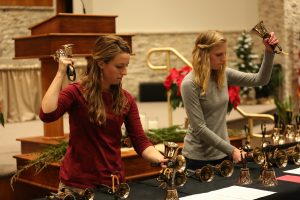
This last Sunday at Lighthouse Baptist, we finally started reading music. After spending the first three weeks practicing only two techniques (ringing and damping), I decided that the ensembles were ready for the next challenge.

Boy, was it a challenge! The adults and teens all have a moderate to advanced knowledge of music and can read notes…or so we thought. It took us a few minutes to play our first scale on the printed page, but we finally figured it out.

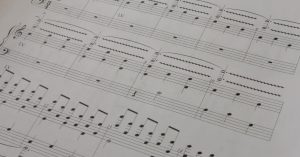
Handbell MusicWe spent rest of the rehearsal practicing basic scales and some chords, all in the key of C major. We had a lot of fun, and almost all the mistakes were things that we could laugh about together.

At the end of the rehearsal, I shared James 1:2-4 with them: “My brethren, count it all joy when you fall into various trials, knowing that the testing of your faith produces patience. But let patience have its perfect work, that you may be perfect and complete, lacking nothing.”

Now, James probably didn’t have music rehearsals in mind when he wrote that passage, but it was enough of a trial for us to remind us that we need to keep working hard while remaining patient. Eventually, we will play some beautiful music together, but until then, we must wait and work and strive to improve.

As for the children’s rehearsal- that was a different story. Almost none of them have prior experience reading music, so we get to start from the beginning with them as they learn to ring together. By the end of the rehearsal we successfully played two scales an octave apart simultaneously…in both directions!

This brings me to my next reason for having a church handbell ministry. You can use it to teach people how to read and play music! That seems like a no-brainer, but perhaps we don’t realize just how much of a blessing this can be to the church.

Music lessons generally are not cheap, especially if they are good ones. Outside of the United States, there are some countries where music lessons in general are scarce. But here in our church we are using handbells to give people free music lessons every week.

Because of the unique nature of handbells and how each person only has a piece of the melody (as discussed in my last post), those who already have a musical background have the opportunity to expand their knowledge base.

For those who do not know how to read and play music, they get to learn something new, and perhaps later they can build on this knowledge by learning to sing or play other instruments.

So there you go! Reason #3 for starting a handbell ministry in your church 🙂

Why Your Church Should Have Handbells- Part 2

Playing the piano is easy, right? Well, okay, maybe not, especially after you watch a virtuoso masterfully pull a classical piece out of the instrument.

Of course your answer to that question depends on your experience at the ivory keys. If you have spent many years developing your abilities on the piano, yeah, you might say it’s easy. But if you don’t even know how pick out a tune one note at a time, you might say it’s extremely difficult.

How about this, try lining up a dozen people at the piano and giving them each only 2-4 keys, no more, no less. Now play a song. Even Mozart and Haydn and Bach would struggle to do that!

It’s much easier to play the piano when both of your hands are controlling handfuls of notes at a time than when you have to share it with several other people and only play a few notes at a time.

Handbell DuetOne of the beautiful things about handbells is the amount of teamwork it requires. It’s the relative equivalent of lining up several people at a piano and giving them each a few keys to plays.

It’s not like an orchestra because in an orchestra you usually have other instruments that can cover up for your mistakes. But a handbell ensemble usually features about a dozen or so soloists who must all play their individual notes at the right time in the right way (oh, and it’s important to play the right notes).

The teamwork aspect is one of my favourite things about handbells. As ringers progress, they can also challenge themselves further by playing in smaller groups.

In a quartet one ringer might be responsible for 5-10 bells, and in a duet a ringer might be responsible for up to 20 bells…or more! Yet a great amount of teamwork is required to fit in with the other ringers at any given time during the song.

Teamwork is extremely important in a local church. Romans 12 and 1 Corinthians 12 both compare the church to the human body, describing the church as the body of Christ: “For as we have many members in one body, but all the members do not have the same function, so we, being many, are one body in Christ, and individually members of one another” (Romans 12:4-5).

Every believer in the body of Christ has abilities that aid the overall ministry of the church, and no two people are alike in what they are able to accomplish. So they must all work together, doing what they do well, so that the body of Christ grows.

One way to teach teamwork in the church is with handbells. It works for children, it works for teens, and it works for adults. Not to mention that it provides a great opportunity for building relationships across ages as people of different levels in life ring together.

Hymn Story: Come, Thou Almighty King

Great Britain OlympicsAs the national anthem played and the gold medalist stood there proudly looking at their nation’s flag, I thought, “What?! For real?!”

Okay, so I’m familiar with the “Star Spangled Banner,” and I know the first two words of the Canadian national anthem, but other than that, I’m quite ignorant of all the other countries.

So when I heard “God Save the King/Queen” being played, I thought it was ironic that America has a distinctly patriotic song to that same tune. I thought, “How typical of us to take a patriotic song from Mother England and put our own words to it so that it communicates the exact opposite message.”

Whenever we hear a tune without words, we immediately associate it with whatever lyrics we learned to that melody. But there are actually many tunes that have more than one set of lyrics associated with them.

What many people don’t realize is that melodies often have their own name unassociated with the song to which they are played. For example, “Holy, Holy, Holy” is sung to a tune called “Nicaea.” So if you hear the tune to this popular trinitarian song without any words, you’re not actually listening to “Holy, Holy, Holy”- you’re listening to “Nicaea.”

“Hyferdol” is a popular tune in many hymnals, probably best known as the tune for “Our Great Savior.” But if you play it in December, it suddenly becomes a Christmas tune with the words “Come, Thou Long-Expected Jesus.”

CrownOkay, now on to the point of this post. Did you know that “Come Thou Almighty King” was once sung to the same tune as “God Save the King”?

This year I’ve decided to study as many hymn stories as possible just for fun, and this is one of my favourites so far.

Nobody knows who penned the words. It once appeared in a pamphlet alongside a Charles Wesley hymn, but no definitive evidence attributes this other song to Wesley.

Regardless of its origin, there is a story about this hymn that seems quite plausible. During America’s struggle for independence, there was a certain day when some British soldiers entered a worship service at a colonial church.

The soldiers commanded the church to sing, “God Save the King.” In a show of submission and clever rebellion, the people sang, “Come, Thou Almighty King” to the same tune of England’s well-known anthem.

It was almost as if the people said, “We have no king but God!”

As the story goes, the soldiers left without doing any harm to the people.

Who is your king? Does your king reside on earth or in heaven?

Here are a couple YouTube videos for your listening pleasure. The first video contains the tune that we associate with the hymn, and the second one is the UK National Anthem.

Try singing the hymn to tune in the second video and imagine what it might have been like to be part of that small congregation 300 years ago that stood up the king’s men.

Why Your Church Should Have Handbells- Part 1

This last Sunday was an exciting day for me. For about three years I’ve dreamed about directing a handbell ensemble, and that dream finally came true, much sooner than I ever expected! Sometimes even those dreams that you don’t dream come true!

In the future I will provide more details about how God provided this unique new opportunity at my church, but in this series of posts I am going to share why I think every church should consider starting a handbell ministry.

Lighthouse Baptist Church has never had this ministry in the past, and as far as I know, we are one of the few Baptist churches in our area to have a ringing ensemble. Fourth Baptist Church is on the other side of the Twin Cities here in Minnesota, and they have a thriving handbell ministry. But aside from them, I don’t know of anyone else nearby.

Why So Few?

Based on my travels around the country and my observations from the orders that came in when I worked in a handbell repair shop, the churches with handbell ensembles are primarily Lutheran, Methodist, Presbyterian, Episcopalian, and Catholic. Oh, and let me add that many of these churches have not just one but *two* sets of bells.

So why don’t more Baptist and non-denominational churches have handbell ministries? I have no idea.

Maybe it’s because we have less money and don’t want to pay for the instruments. Maybe it’s because we often favor more progressive music styles and don’t think that handbells fit into that style.

Maybe we just don’t know much about them and no one is telling us about them.

Lighthouse Baptist is now the second church that I have been part of in the last few years that has decided to start a handbell ministry, and I think it is a very positive move. Today I am going to share just one reason why.

Bell RingingA Unique Opportunity

Handbells offer a unique opportunity to teach biblical truth.

Yeah, but why do we need need to spend thousands of dollars on new instruments and start a new ministry just to do that?

Great question! But slow down…that’s only the first reason. I’ll give more in the future. Right now let me explain this one.

Hopefully we teach biblical truth in our churches with the sermons, the singing, the Sunday School classes, the conferences, and the Bible studies. But for the most part, those are all lecture-type settings.

But handbells are hands-on, and they require immediate application.

When I preach or teach, I’m a huge proponent of offering practical ideas for application and implementation of biblical truth. You should never conclude a teaching time without telling people how to implement what they have learned as soon as they leave the building.

Once they leave, only time will tell if people respond or not.

But in handbells, ringers are forced to immediately apply what they are learning, or the group won’t progress. The theoretical instantly becomes reality. This provides ensemble directors with the opportunity to show people the difference between doing things one way and doing things another way.

So how does this enable the church to teach biblical truth?

More than Music

This week we spent the whole rehearsal learning basic ringing techniques. We are going to do the same thing next week…and the week after that…and the week after that.

Why? Because they need to know the basics before they can move on to the more advanced. They need a strong foundation so they don’t develop bad habits.

In other terms, we could say that they need to learn the elementary principles of ringing. (Does that terminology ring a bell? 😉 If not, it will soon.)

But if I told them that they need to learn the basics and then I immediately started teaching them more advanced techniques, I would undermine my own authority. My mouth would say, “The basics are really important,” but my actions would say, “Just kidding!”

I can assure you, however, that at the end of this month, my ringers will know the basics exceptionally well. They will have no choice because I won’t give them a choice 🙂

Not only will they hear me talk about it, but they will experience immediate application. Either that or they won’t continue to ring with us.

I told my ringers on Sunday that we are going to end every rehearsal by applying the day’s rehearsal to a truth from Scripture.

This week we compared our rehearsal time to the truth taught in Hebrews 5:12-14: “For though by this time you ought to be teachers, you need someone to teach you again the first principles of the oracles of God; and you have come to need milk and not solid food. For everyone who partakes only of milk is unskilled in the word of righteousness, for he is a babe. But solid food belongs to those who are of full age, that is, those who by reason of use have their senses exercised to discern both good and evil.”

Many people in our churches have been reborn long enough that they ought to be able to teach and disciple other believers. Unfortunately, they have not reached full maturity yet because they have not been properly fed! They need more milk!

Likewise, our ringers need a solid foundation in the basics before they can move on to greater things.

Wrapping It Up

Here’s the conclusion. The ringers at Lighthouse Baptist have been told that they need to learn the basics. For four weeks they will apply what I have told them by actually doing nothing but the basics.

They will experience hands-on what it means to implement what I have asked them to do, and they will eventually see the difference it makes.

As a result, I can also take biblical truth and apply it to our hands-on “experiment.” When they think of Hebrews 5:12-14, they can think back to when they spent a month “drinking the milk” of handbells.

For the most part, when you preach or teach, you can tell people how to apply Scripture, and you can give them illustrations, but it’s harder to give them that visual, hands-on illustration that says, “See, this is why.”

But with handbells you can do that, and at Lighthouse, that is exactly what we will do.

Thanks for reading, and if you’d like to be notified every time I post something new, simply subscribe to my email notifications on the sidebar.

Echo His praises!

Blest Be the Tie that Binds

As I launch this new website, I wanted to post a song I recently worked on because it has special significance today, March 1.

I grew up in Mason City, IA and attended Faith Baptist Church. After our monthly communion service, we would welcome new members with a “right hand of fellowship” and sing the song “Blest Be the Tie that Binds.” As a result, I grew up knowing the first stanza of this song very well.

Last summer I visited Lighthouse Baptist Church as I prepared to join the church as an assistant pastor, and the Sunday night that I was here we had communion. At the end of the service, everyone gathered in a big circle around the sanctuary, joined hands, and sang the same song that I grew up hearing on Communion Sunday.

However, at Lighthouse Baptist Church, we also sing the fourth stanza, and it was new to me. But the words were so powerful that I instantly gained a new appreciation for the song. It talks about the relationship that believers enjoy with each other as a part of the body of Christ. Here’s a little history about the author and the possible background of the song if you’re interested: Hymn Story: Blest Be the Tie that Binds.

LolaWhen my grandma on my dad’s side (we call her Lola) passed away at the beginning of this year, this song came to mind, and I thought about hope we have in Christ and the heavenly reunion that will take place someday. So I decided to take this song and add an eschatological refrain to each stanza.

My Lola was born on February 29, 1920. As a result, three out of every four years her birthday was celebrated on March 1, so today we would have celebrated her 97th birthday. She loved music, and her generosity over the years was one of the reasons my family has been able to continue developing our musical abilities.

So in memory of my Lola, the first song on the Echoing His Praises website is “Blest Be the Tie that Binds” with a forward-looking refrain.

You can download this song for free and listen to a piano rendition of it on my downloads page.

Thanks for stopping by, and be sure to subscribe on the sidebar to get email updates when I post new content!